

Fire props explained: A practical guide for event planners

TL;DR:
Understanding the distinct categories of fire props and their specific regulations is crucial for planning safe, compliant fire performances. Proper safety measures, environmental monitoring, and clear communication are essential to prevent incidents and ensure memorable events. Contingency planning and early coordination with professionals help manage risks and facilitate high-quality, spectacular fire shows.
Most event planners assume that booking a fire performer means working with one standardized set of rules. That assumption causes more last-minute show cancellations and permit rejections than almost any other planning mistake we see. Fire performance props actually fall into three distinct categories, each governed by different regulatory frameworks, safety protocols, and permit requirements. Understanding these distinctions from the start lets you choose the right effects, secure proper approvals, and deliver a show your guests will remember for the right reasons. This guide walks you through everything you need to know.
Table of Contents
Key Takeaways
Point | Details |
Know your fire prop type | Differentiate between open-flame, flame-effect machines, and pyrotechnics to ensure correct planning. |
Permits are mandatory | Always secure the right permits and safety protocols to keep your show legal and safe. |
Environmental checks matter | Adapt to wind and space constraints by reassessing safety right up to showtime. |
Safety unlocks creativity | Treating rules as non-negotiable not only prevents incidents but allows for greater performance freedom. |
What are fire performance props?
When most people picture fire entertainment, they imagine a performer spinning fire poi or twirling a flaming staff. Those are open-flame tools, and they are just one slice of what fire props actually include. Knowing the full picture helps you make smarter decisions when matching effects to your event vision and venue.
Fire prop types fall into three major categories. Open-flame tools include poi, staff, fans, rope dart, hoops, and contact balls. These are the props most commonly associated with fire dancing, where wicks soaked in fuel are ignited and manipulated by skilled performers. Flame-effect machines are mechanical or electronic systems that produce controlled bursts or sustained flames, often used as stage design elements or dramatic scene setters. Pyrotechnic devices include sparkle fountains, aerial shells, and flash effects, which involve chemical reactions and carry the strictest regulatory requirements of all three types.
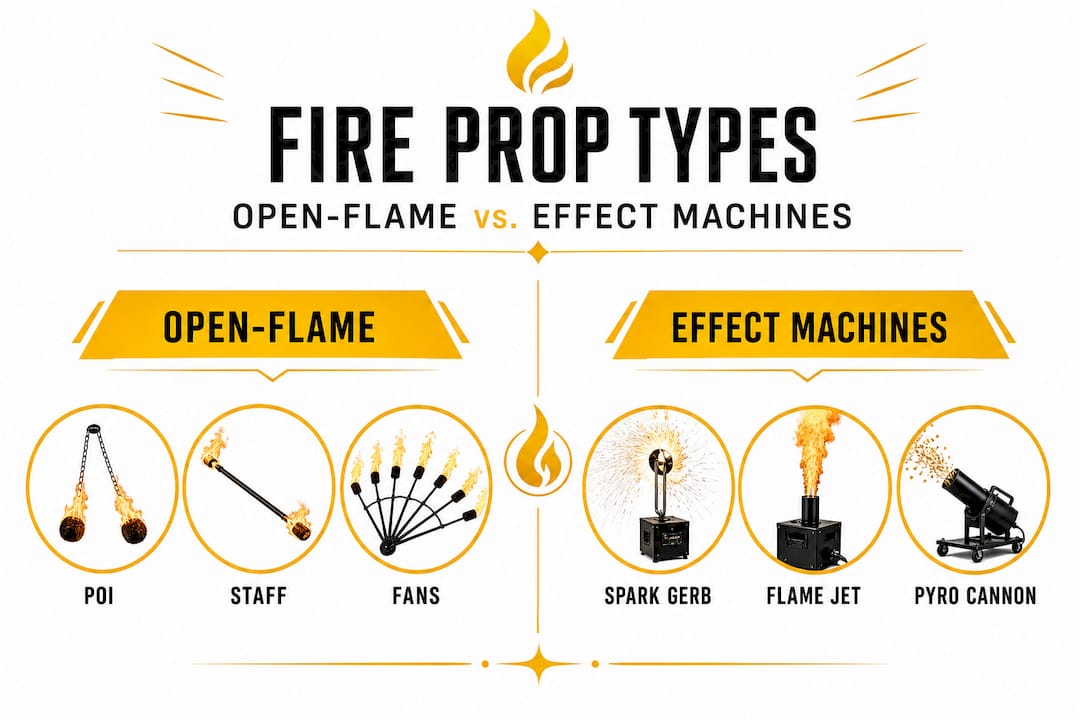
Each category is regulated differently. As NFPA 1126 outlines, fire performance props can mean open-flame tools, flame-effect machines, or pyrotechnic effects, with different regulations for each. Separately, NFPA 160 handles flame effects before an audience under distinct guidance from pyrotechnics. These are not interchangeable standards. Treating them as one creates serious compliance gaps.
Here is a quick comparison to keep things clear:
Prop category | Common examples | Primary standard | Typical permit level |
Open-flame tools | Poi, staff, fans, hoops | Local fire codes | Moderate |
Flame-effect machines | Propane jets, fire columns | NFPA 160 | High |
Pyrotechnic devices | Aerial shells, sparkle effects | NFPA 1126 | Strictest |
Beyond the regulatory table, there are practical differences that affect your planning. Open-flame tools require trained performers and a clear safety perimeter, but they are the most portable and adaptable to different venues. Flame-effect machines need advance site assessment because of fuel storage and equipment setup requirements. Pyrotechnic devices usually require a licensed pyrotechnician on-site, not just a fire performer. Understanding how fire props transform events helps you decide which category best fits your audience size, venue type, and budget before you ever reach the permit stage.
Some popular open-flame tools you will encounter include:
Fire poi: Weighted wicks on chains or cables, swung in geometric patterns
Fire staff: A solid rod with wicks at each end, spun and tossed
Fire fans: Handheld fan-shaped props with wick-tipped spokes
Fire hoop: A large hoop with evenly spaced wicks, danced with and around the body
Rope dart: A single long cord with a wick tip, used for long-range swinging and precision wraps
Each of these creates a very different visual footprint, and each has specific spacing requirements that affect where in your venue they can be performed safely.
Key safety and regulatory fundamentals
With a clear picture of fire prop categories, you can move into the non-negotiables of safety and compliance. These requirements are not suggestions. They are the framework that keeps your event legal, your guests safe, and your performers able to do their best work.
The foundational elements of a compliant fire performance setup include a defined safety perimeter, fire extinguisher readiness, a detailed site plan, and dedicated safety assistants. A Denver-area fire permit checklist confirms that fire performance safety includes a defined safety perimeter, fire equipment readiness, a site plan, and staffed assistants. These requirements are consistent across most jurisdictions, though specifics vary by city and state.
Here is the standard sequence of safety steps planners should work through before any fire performance:
Identify the prop category and confirm which regulatory standard applies (NFPA 160, NFPA 1126, or local open-flame codes).
Contact your local fire marshal to understand specific permit requirements for your jurisdiction and venue type.
Prepare your site plan showing performer position, audience perimeter, fire extinguisher placement, and emergency exit routes.
Confirm staffing for safety assistants, including how many are required per performer and what equipment they must have on hand.
Conduct a pre-event event site safety inspection to validate that conditions match your permitted plan.
Brief all venue and event staff on fire emergency protocols before the performance begins.
Environmental factors deserve special attention, and they are frequently underestimated by planners focused entirely on permits and paperwork. Flame spread is sensitive to environmental parameters like wind and terrain, which means conditions at your outdoor event can shift performance risk significantly within just a few minutes. Wind speed, direction, nearby structures, and ground cover all factor into how a fire performance behaves in real time.
“Wind and terrain directly affect how flame and fire spread in any environment. What looks safe in calm conditions can shift quickly when a breeze picks up.” This is why on-site monitoring throughout your event is not a luxury. It is part of your safety plan.
This is also where the regulatory standards for fire performance safety draw a sharp line. NFPA 1126 and NFPA 160 both define requirements for using pyrotechnics and flame effects before an audience, and those requirements include provisions for adverse conditions.
Pro Tip: Always treat permit requirements as mandatory baseline minimums, not optional guidelines. Many planners learn the hard way that a single overlooked checklist item can halt an entire show minutes before it starts.
Here is a quick reference for common safety perimeter distances:
Prop type | Minimum audience distance | Safety assistant requirement |
Open-flame tools | 10 to 15 feet | One assistant per performer |
Flame-effect machines | 20 to 30 feet | Trained operator plus assistant |
Pyrotechnic devices | 70 to 100+ feet | Licensed pyrotechnician required |
These numbers vary by local code, so always verify with your fire marshal. They are starting points for planning, not final approvals.
Planning for success: How to choose and implement fire props at events
Regulations and essentials are the foundation. Now let’s talk about translating that knowledge into smooth, practical event planning that actually delivers a great show.

Aligning your fire prop selection with your event goals starts with asking three core questions. What experience do you want to create for your audience? What does your venue physically allow? And what is your realistic timeline for permits and rehearsals? Answers to these questions will steer you toward the right prop category before you go any further.
The impact of fire performances on event energy is significant, whether you are planning a product launch, a private party, a wedding reception, or a corporate gala. The right fire effect amplifies your theme. The wrong one can clash with your venue’s limitations or require permits you cannot obtain in time.
Here is the step-by-step planning sequence we recommend:
Define the effect you want. Is it ambient and flowing, or dramatic and high-impact? This guides your prop category choice.
Check permit timelines. Some jurisdictions require fire performance permits 30 to 60 days in advance. Start this process immediately.
Review venue suitability. Ceiling height, ventilation, flooring material, and proximity to fire suppression systems all matter.
Coordinate with your performers early. Certified fire performers can flag site issues you might miss and help you prepare accurate permit applications.
Rehearse emergency responses. Everyone involved, from venue staff to event coordinators, should know what to do if something unexpected happens.
Verify insurance coverage. Do not assume your standard event insurance covers fire acts. Many policies exclude them or require a specific rider.
Common planning mistakes include treating safety recommendations as optional, underestimating how wind changes outdoor risk, and assuming standard event insurance automatically covers fire performances. Each of these mistakes has derailed real events. Permit-style requirements demand both quantitative separation and safety staffing, and planners should treat these as firm requirements, not suggestions that can be scaled back under budget pressure.
Pro Tip: Bring your certified fire performers into the planning conversation as early as possible, ideally before you finalize your venue contract. Their practical experience will surface requirements and opportunities you will not find in any checklist.
One more consideration: indoor events carry different challenges than outdoor ones. Smoke management, sprinkler system sensitivity, and fuel storage become more complex inside a venue. Outdoor events offer more space but introduce wind and surface variables. Both settings are absolutely workable with the right preparation.
Troubleshooting and adaptive fire prop management
Even the best-planned fire performances encounter surprises. Weather shifts, permit paperwork errors, venue layout changes, or a performer arriving to find a condition that wasn’t there during the site check. The planners who handle these moments well are the ones who build adaptation into their plans from the start.
When environmental conditions change, here is how to respond effectively:
Monitor wind speed continuously at outdoor events using a handheld anemometer (a small, portable device that measures wind speed). Most experienced fire performers carry one.
Establish a clear go or no-go threshold with your fire team before the event. Decide in advance at what wind speed you pause or cancel, so there is no confusion in the moment.
Have a backup timing plan. If conditions require delaying the performance, communicate this to your event timeline immediately rather than absorbing the delay silently.
Keep fire extinguishers accessible and inspected throughout the event, not just positioned and forgotten.
Designate one point of contact on your team for real-time communication with the fire performers and venue safety staff.
“Evidence demonstrates that changing environmental conditions, particularly wind and air currents, require ongoing risk reassessment throughout a performance, not just at setup.” Treating your site safety rechecks as continuous rather than one-time gives you the flexibility to adapt rather than react.
When to pause or cancel is a judgment call, but it should be guided by the criteria you set in advance. If wind exceeds your agreed threshold, pause. If your venue’s fire suppression system activates unexpectedly, stop immediately. If any performer reports a safety concern, that concern takes priority over the show schedule. These are not failures. They are the system working as intended.
Communication is the often-overlooked factor in troubleshooting. Real-time adjustments only work if your fire team, venue staff, and event coordinators are all using the same channel and sharing the same information. Agree on communication methods, whether that is radio, group text, or a designated runner, before the event starts.
Rethinking fire props: Why smart planners treat safety protocols as non-negotiable
Here is something worth saying plainly: the planners who push back against safety protocols are not creating more exciting events. They are creating more fragile ones.
We have seen it happen. An event team assumes that because a previous show went fine with a shorter safety perimeter, the requirement must be conservative. They compress the audience distance. The performance runs without incident, and they feel validated. But what they have actually done is remove the margin that protects them when something unexpected happens. And in live fire performance, unexpected things happen.
The counterintuitive truth is this: rigidly following protocols actually opens up more creative possibilities. When your safety perimeter is properly established and your permits are secured, experienced performers can push further in their routines. They know the boundaries, the audience is protected, and the venue is on board. That foundation of trust and compliance is what makes ambitious, high-energy performances possible.
The events we find most memorable are never the ones where corners were cut. They are the events where every detail was handled so thoroughly that the performers could focus entirely on their craft. A thoroughly prepared environment gives fire performer tools room to shine because everyone on the ground is confident, not anxious.
The hard-won lesson from years of working events: the time you invest in permits, site inspections, and safety briefings pays back every dollar and hour during the performance itself. Treat protocols as creative infrastructure. That is the mindset that produces consistently spectacular results.
Bring fire performances to your event—safely and seamlessly
You now have the knowledge to plan a fire performance with confidence. Putting that knowledge into action is even easier when you work with professionals who handle the details alongside you.
Our team connects event coordinators and private party planners with certified fire performers and offers fire performance consultation to guide you through prop selection, permit preparation, and safety planning. We work with your venue, your timeline, and your vision to make the process smooth from the first conversation to the final bow. Explore the full range of fire performance services we offer, and get a clear picture of what fire dancers use to create those stunning effects. Let’s build something extraordinary together.
Frequently asked questions
Are all fire props governed by the same regulations?
No, open-flame props, flame-effect machines, and pyrotechnics each fall under different regulatory standards and permit requirements. NFPA 1126 governs pyrotechnics while NFPA 160 applies to flame effects before an audience.
What are the mandatory safety measures for fire performances at events?
Mandatory measures include a clear safety perimeter, fire extinguishers, assistants for each performer, and a detailed site plan. A standard fire permit checklist confirms these as baseline requirements across most jurisdictions.
How should planners respond if wind or weather conditions change?
Planners must re-evaluate fire risks and may need to pause or cancel the performance for safety. Scientific research confirms that flame and fire spread are directly affected by wind and terrain changes.
What should I do if my venue has never hosted fire performances before?
Consult early with venue staff, your fire performers, and event safety officials to address permits and procedures together. Starting this conversation at least 60 days before your event gives everyone enough time to prepare and approve the plan correctly.
Recommended
Comments