

Fire performance insurance guide for event planners


TL;DR:
Proper fire performance insurance involves multiple coverage types, including general liability, equipment, and fire legal liability, to mitigate risks effectively. Venues require specific policy limits, endorsements, and proof of coverage documented through Certificates of Insurance with accurate details and active endorsements. Proactive planning, early COI requests, and understanding coverage scope are essential for safe and compliant fire performances.
Booking a fire performer feels exciting until the venue asks for a Certificate of Insurance and you realize you’re not sure what they actually need. This fire performance insurance guide exists because that moment catches most event planners off guard. Fire acts carry risks that standard event policies don’t cover well, and venues know it. The wrong documentation, a missing endorsement, or an outdated policy can halt your booking entirely or, worse, leave you legally exposed after an incident. Here’s everything you need to know to move from confused to fully covered.
Table of Contents
Venue requirements and insurance mandates for fire performances
Navigating Certificates of Insurance (COIs) and endorsements
Practical steps for event planners managing fire performance insurance
Rethinking fire performance insurance: lessons most event planners overlook
How Radiate Fire Perform supports your fire performance insurance needs
Key Takeaways
Point | Details |
Core coverage types | General liability, equipment, professional liability, and venue protections are essential for fire performance insurance. |
Venue insurance mandates | Venues require minimum liability limits, additional insured endorsements, and specific waiver endorsements on COIs. |
Understand COIs | A certificate of insurance proves coverage but only additional insured endorsements protect venues legally. |
Cost considerations | Single-event insurance starts around $59; annual policies offer cost efficiency for frequent performers. |
Document management | Request COIs early with accurate venue details and endorsements to ensure compliance and avoid risks. |
Understanding fire performance insurance essentials
A fire performance insurance guide starts with knowing what coverage types actually exist and what each one does. These aren’t interchangeable. Each type protects against a different kind of risk.
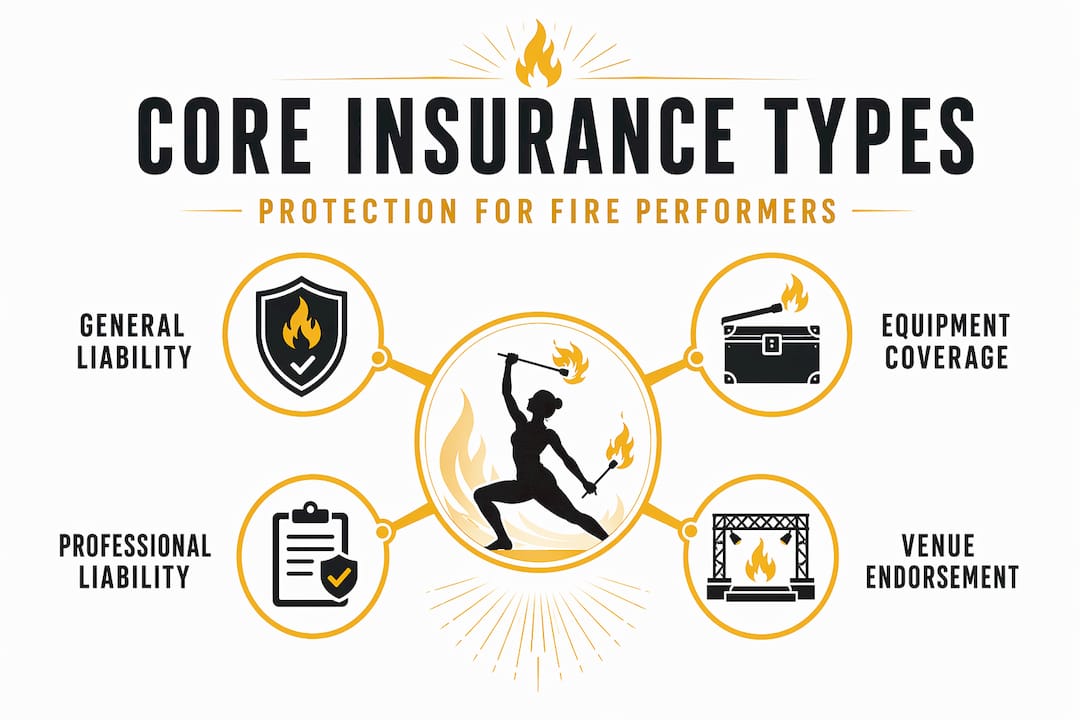
General liability is the core coverage protecting against third-party claims related to injuries or property damage during fire performances. If an audience member gets hurt or a flame scorches a venue wall, general liability is what responds first. It’s the non-negotiable foundation of any fire insurance policy.
Beyond general liability, here are the other key coverage types you’ll encounter:
Equipment coverage: Insures fire props, poi, staffs, torches, and fuel storage equipment against theft or damage. Fire performance gear is expensive, and replacing it out of pocket after a van break-in or prop failure is a real risk.
Professional liability: Protects against claims that a performance caused harm due to errors or negligence in how it was executed. This is separate from general liability and matters for performers offering instruction or creative direction.
Fire legal liability: Covers damage specifically to rented or borrowed premises caused by fire. Many venues require this as a standalone addition to a performer’s policy.
Additional insured endorsements: This is how venues get direct protection under the performer’s policy, not just a notification that coverage exists.
Understanding how these pieces fit together helps you manage your fire performance workflow from contract to curtain call without surprises. Most venues require performers to be added as additional insured on the policy, which is different from simply having insurance. That distinction matters enormously.
Venue requirements and insurance mandates for fire performances
Venues that host fire acts have learned from experience. Their insurance requirements are specific, and they aren’t negotiable.
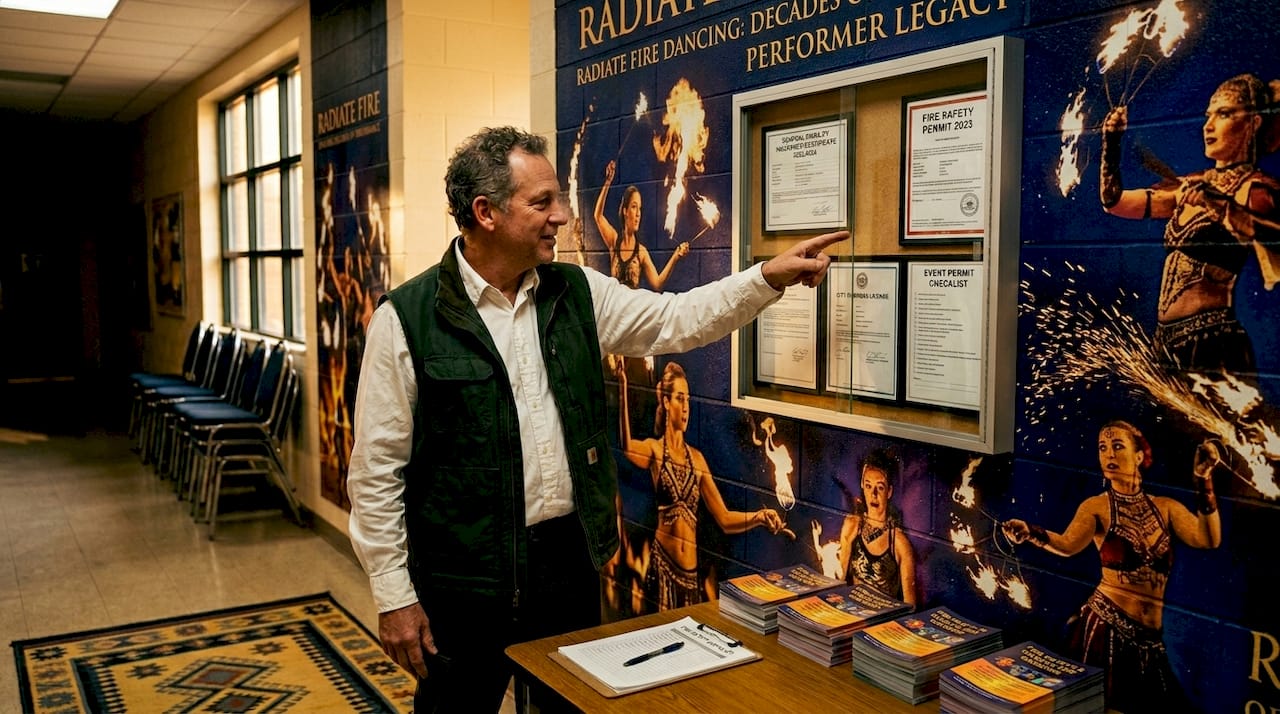
Venues typically mandate general liability coverage of $1M to $2M per occurrence and require additional insured endorsements to protect themselves. Most contracts also call for fire legal liability coverage, waiver of subrogation, and primary/non-contributory language. Doing a thorough site inspection for fire performances before finalizing your insurance request helps you identify any venue-specific conditions that affect coverage needs.
Here’s a quick comparison of what standard versus premium venue requirements typically look like:
Coverage element | Standard venue requirement | Large or high-profile venue |
General liability per occurrence | $1,000,000 | $2,000,000 |
General liability aggregate | $2,000,000 | $4,000,000 |
Fire legal liability | $100,000 | $300,000 |
Additional insured endorsement | Required | Required |
Waiver of subrogation | Sometimes required | Almost always required |
Primary/non-contributory | Rarely required | Frequently required |
Additional insured endorsements, waiver of subrogation, and primary/non-contributory language are critical on COIs to meet venue contract terms. These aren’t just formalities. They determine who pays first in a claim and whether the venue can seek reimbursement from the performer’s insurer.
Key requirements most venues include in their fire performer contracts:
Minimum $1M per occurrence, $2M aggregate general liability
Certificate of Insurance naming the venue as additional insured
Fire legal liability coverage for damage to rented premises
COI coverage dates that include setup, event day, and teardown
Primary/non-contributory language protecting the venue from bearing costs first
Pro Tip: When booking fire performances or outdoor venues near water, ask specifically whether the venue has additional environmental liability requirements. Some outdoor sites add conditions that indoor venues don’t.
Navigating Certificates of Insurance (COIs) and endorsements
A COI is a document that proves active insurance exists. It is not coverage itself, and this distinction trips up event planners constantly.
“A Certificate of Insurance only summarizes policy details. It does not grant rights to a third party or modify coverage. Only the actual policy or endorsement does that.”
Listing venues only as certificate holders on COIs provides zero protection. Only additional insured endorsements offer real coverage. A venue named only as a “certificate holder” gets notified if the policy is canceled. That’s it. They get no direct coverage under the performer’s policy.
Here’s a step-by-step process for managing COIs correctly:
Request the COI and endorsement together. Ask the performer or their broker to send both the COI and the actual additional insured endorsement page. One without the other is incomplete.
Verify the venue’s legal name. The name on the endorsement must match the venue’s legal entity name exactly. A nickname or shortened version can void the endorsement.
Confirm the venue address is listed. Some endorsements are location-specific. Make sure your venue’s address is on the document.
Check the coverage dates. The policy period must cover setup day, performance day, and teardown day. A COI that only lists the performance date leaves setup and breakdown exposed.
Confirm carrier ratings. Look up the insurer’s A.M. Best rating. You want at least an A-rated carrier. Unrated or low-rated carriers may not pay claims reliably.
File organized copies. Store COIs and endorsements together in your event file. You may need them months later if a claim arises.
Request COIs at least 2-3 weeks before the event, ensuring the exact venue legal name and address are used for endorsements. Waiting until the week of the show is the single biggest mistake we see. Endorsement corrections take time, and errors are common on first drafts.
Pro Tip: Build COI review into your private party fire performance workflow as a formal checklist step, not an afterthought. It will save you scrambling every time.
Cost and coverage options for fire performance insurance
Not every fire performer buys the same type of policy, and your job as an event planner is to understand what they have before you assume it covers your event.
Annual fire performer insurance policies typically range from $199 to $900 depending on coverage and frequency, while event-based policies start at around $59 for up to three days. For a performer who does 20 or more shows a year, annual coverage is almost always the smarter financial choice. For a one-off artist booked for a single corporate event, a single-event policy works fine.
Policy type | Cost range | Best for | Coverage duration |
Single-event policy | $59 to $250 | Occasional performers, one-off bookings | 1 to 3 days |
Annual policy | $199 to $900 | Frequent performers, multiple shows | 12 months, unlimited shows |
Annual with equipment rider | $300 to $1,200 | Performers with high-value props and gear | 12 months |
Performers can get annual policies at $199/year or event policies starting at $59 covering up to three days. The type of fire act also affects pricing. A solo fire dancer costs less to insure than a troupe performing with fire staffs, poi, and fire dancing props like rope darts near seated audiences.
Factors that influence premium costs include:
Act type and props used: More complex acts with multiple fire sources cost more.
Audience proximity: Performances close to crowds carry higher risk ratings.
Venue type: Indoor venues typically cost more to insure than open outdoor spaces.
Coverage limits: Higher per-occurrence limits increase premiums but may be required for larger events.
Performance frequency: More shows per year push performers toward annual policies for better value.
If you manage fire performances for themed events regularly, budgeting for insurance early in your planning timeline prevents last-minute surprises. Build it into your performer contract terms so that COI requests have proper lead time.
Pro Tip: Ask performers whether their policy includes a blanket additional insured option. Some annual policies allow unlimited additional insured requests at no extra cost per event, which saves time and money for planners working with the same performer across multiple venues.
Practical steps for event planners managing fire performance insurance
Knowing what insurance looks like and actually managing it across multiple events are two different things. Here’s a practical process that keeps you covered every time.
Start verification at least 2 to 3 weeks out. Request COIs 1-2 weeks before performances with precise venue details to meet the vast majority of contractual requirements. Earlier is always better.
Get the endorsement, not just the COI. Ask explicitly for the additional insured endorsement page. Failing to verify formal endorsements, not just COI listings, can leave venues at risk during claims.
Confirm the legal venue name. Pull the venue contract and copy the exact legal entity name into your COI request to the performer.
Check that all event days are covered. Setup, performance, and teardown must all fall within the policy period. One uncovered day creates real exposure.
Verify the carrier’s A.M. Best rating. Require an A-rated or better carrier. This matters if a claim ever needs to be paid.
File everything together. Keep the COI, endorsement, and waiver of subrogation in a single event folder. Digital and physical copies both have value.
Communicate expectations early. Share your venue’s insurance requirements with the fire performer at the time of booking, not the week before the show.
A thorough site inspection guide approach applies here too. The same discipline that keeps a fire performance physically safe is the discipline that keeps its paperwork clean. Treat insurance verification the same way you treat safety checks: systematically and without shortcuts.
Pro Tip: Create a reusable insurance requirements sheet for your events that lists your venue’s exact legal name, address, required limits, and endorsement language. Send it to every performer at booking. It eliminates back-and-forth and gives performers exactly what they need to pull the right documents immediately.
Rethinking fire performance insurance: lessons most event planners overlook
Here’s something we see again and again. An event planner receives a COI from a fire performer, files it, and considers the insurance box checked. The show goes off beautifully. But if something had gone wrong, the venue would have discovered too late that they had zero coverage because the COI listed them only as a certificate holder.
The most expensive insurance mistake isn’t failing to ask for a COI. It’s accepting one without understanding what it does and doesn’t do. Planners with years of experience make this error. It’s not about competence. It’s about not knowing what questions to ask.
We’ve also seen the damage that rush requests cause. When a performer scrambles to produce a COI three days before an event, errors sneak in. The wrong venue name. Missing addresses. A policy period that starts on performance day instead of setup day. These aren’t rare exceptions. They’re common outcomes of late requests and insufficient lead time.
The other overlooked issue is the event lifecycle gap. Most planners think of the performance day as the only day of risk. But injuries and property damage happen during load-in and teardown just as easily as during the show itself. Insisting that the COI explicitly cover all three phases of the event is a non-negotiable standard we apply to every booking.
Integrating insurance review into your standard event planning workflow through your site inspection insights process and booking checklist turns what feels like a bureaucratic hurdle into a routine step. That shift in mindset is where real risk management begins.
How Radiate Fire Perform supports your fire performance insurance needs
Navigating fire performance insurance doesn’t have to feel like navigating it alone. At Radiate Fire Perform, we work directly with event planners to make the insurance and safety side of fire entertainment as clear as the performance itself.
Our fire performance services walks you through venue-specific insurance requirements, helps you identify what to request from performers, and ensures your event meets compliance standards from the start. Our shows are delivered by insured, experienced fire dancers who understand what venues need and can turn around COIs efficiently. Explore our learning about fire dancing resources to build your knowledge base, from safety protocols to understanding the fire dancing props performers use. We’re here to make fire performance accessible, safe, and fully compliant for your events.
Frequently asked questions
Why is general liability insurance essential for fire performers?
General liability is the most essential coverage for fire performers due to third-party claims from open flames. It protects both the performer and the event organizer against bodily injury and property damage claims arising from the act.
Can a venue be protected by just being listed as a certificate holder on a COI?
No. Listing venues only as certificate holders provides zero protection. Only additional insured endorsements extend the performer’s policy to cover the venue directly.
How far in advance should event planners request Certificates of Insurance for fire performances?
Event planners should request COIs at least 2 to 3 weeks before fire performances to allow time for corrections, endorsement updates, and venue name verification.
What costs should event planners expect for fire performance insurance?
Event policies start around $59 for up to three days of coverage, while annual policies range from $199 to $900 depending on coverage options, act type, and performance frequency.
Does fire performance insurance cover equipment and props?
Yes, but only if the performer has added an equipment rider to their policy. Equipment coverage safeguards valuable fire props and performance gear against damage or theft, and it is typically an optional add-on rather than included by default.
Recommended
Comments